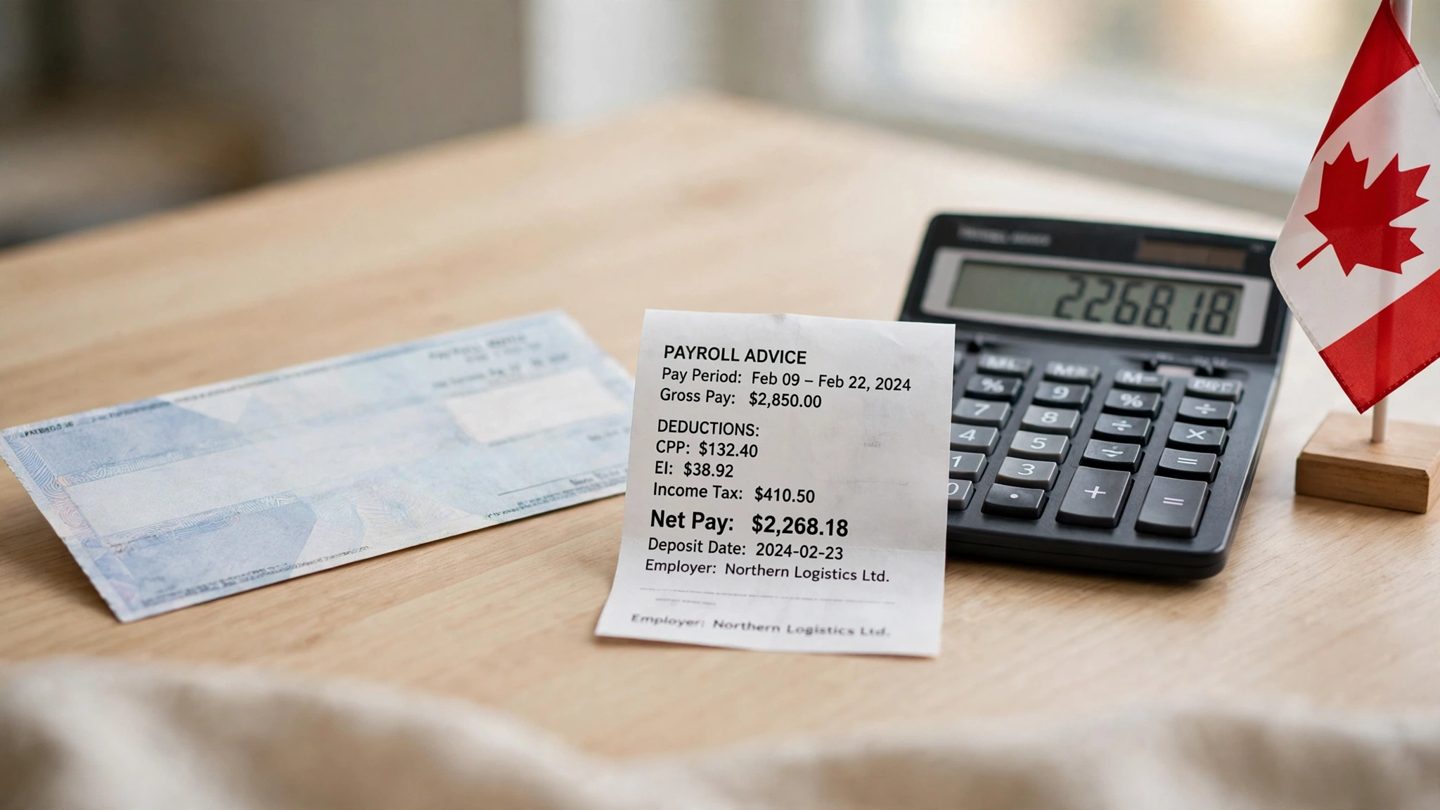
CPP EI 2027 changes take effect on January 1, 2027, and most Canadian workers will see a different amount in their first paycheck of the new year. The Canada Pension Plan rate is falling, while Employment Insurance premiums and the maximum EI benefit are both rising. The net result depends on how much you earn, but for many middle-income workers the CPP cut will outweigh the small EI increase.
Here is what changes on January 1, what it is worth in dollars, and why a lower CPP rate does not mean a smaller CPP pension when you retire.
CPP rate drops — but the ceiling rises
From January 1, 2027, the employee CPP rate falls from 5.95% to 5.75% outside Quebec. The cut comes from the base CPP rate, which drops from 4.95% to 4.75% under Bill C-30, assented on June 18, 2026. The 1% CPP enhancement is unchanged, and the change is legislated, not a proposal.
At the same time, the year’s maximum pensionable earnings (YMPE) rises from $74,600 to $76,700, and the year’s additional maximum pensionable earnings (YAMPE) rises from $85,000 to $87,400, according to the Canada Revenue Agency (CRA) on October 28, 2026. That means CPP applies to more of a high earner’s pay, even though the rate on each dollar is lower.
The maximum employee CPP contribution falls from $4,230.45 to $4,209.00, while the maximum CPP2 contribution rises from $416 to $428. The basic exemption stays at $3,500. Self-employed workers will pay a CPP rate of 11.50%, down from 11.90%, to a maximum of $8,418.00.
For a worker earning $70,000, the rate cut is worth about $133 a year. The higher earnings ceiling offsets part of that saving for people earning above the old YMPE, because more of their pay is now subject to CPP. Workers earning well above the YAMPE will see little change in their total CPP contribution, since the lower rate and the higher ceiling largely cancel each other out.
Importantly, the rate cut does not reduce CPP pensions. A CPP pension is based on pensionable earnings, not on the rate paid, so paying a lower rate on the same earnings does not shrink the pension you have earned. For the payment schedule around the change, see our guide to CPP, OAS and GIS payment dates.
EI premiums edge up — and the maximum benefit rises
Employment Insurance moves in the opposite direction. The employee EI premium rate rises from 1.63% to 1.64% per $100 of insurable earnings outside Quebec, while the employer rate is 2.30%. Maximum insurable earnings (MIE) rise from $68,900 to $70,800.
As a result, the maximum employee EI premium rises from $1,123.07 to $1,161.12, and the maximum employer premium is $1,625.57. Most workers will pay only a few dollars more a year, because the rate increase is just one cent per $100 of insurable earnings.
There is better news for people who need EI. The maximum weekly EI benefit rises from $729 to $749, at 55% of insurable earnings. The new maximum applies to claims starting on or after January 1, 2027. The $729 figure was the maximum weekly EI benefit in 2026, so a worker at the top of the scale will receive $20 more per week in 2027.
What it means for your paycheck
Put the two changes together and the picture is straightforward. At a $70,000 salary, the CPP saving of about $133 a year is partly offset by a slightly higher EI premium, leaving most workers in that range modestly ahead. Lower earners keep more of the CPP saving, because they are further from the EI and CPP ceilings. Higher earners pay CPP on more of their income, so their net change is smaller.
Employers will also see a change. They match the employee CPP contribution and pay EI at 1.4 times the employee rate, so payroll costs move with the same rates and ceilings. Payroll teams should update their systems before the first pay period in January, because the new rates and maximums apply from January 1, not from the first pay date after it.
The January changes sit alongside other payments at the start of the year. Our guide to Canada January 2027 benefits, CPP and CGEB payment dates sets out what is paid in the first month of 2027, and our Canada benefit payment dates for November and December 2026 cover the payments due before the new rates begin.
Quebec is different
All of the figures above apply outside Quebec. Quebec workers pay into the Quebec Pension Plan (QPP) instead of CPP, and Quebec has its own EI premium rates: 1.29% for employees and 1.81% for employers. If you work in Quebec, check the QPP and Quebec EI figures for 2027 rather than the CPP and EI rates in this article.
FAQ: CPP EI 2027
Will the CPP rate really fall in 2027?
Yes. The employee CPP rate falls from 5.95% to 5.75% on January 1, 2027, outside Quebec. The base rate drops from 4.95% to 4.75% under Bill C-30, assented on June 18, 2026, while the 1% CPP enhancement is unchanged.
Will my CPP pension be smaller because the rate falls?
No. A CPP pension is based on pensionable earnings, not on the contribution rate. Paying a lower rate on the same earnings does not reduce the pension you have earned.
How much EI will I pay in 2027?
Outside Quebec, employees will pay 1.64% per $100 of insurable earnings, up from 1.63% in 2026. The maximum employee premium is $1,161.12, based on maximum insurable earnings of $70,800.
What is the maximum weekly EI benefit in 2027?
The maximum weekly EI benefit is $749 in 2027, up from $729 in 2026. It is 55% of insurable earnings, and the new maximum applies to claims starting on or after January 1, 2027.
Does this apply in Quebec?
No. Quebec pays QPP instead of CPP, and its EI rates are 1.29% for employees and 1.81% for employers. The CPP and EI figures in this article apply outside Quebec.